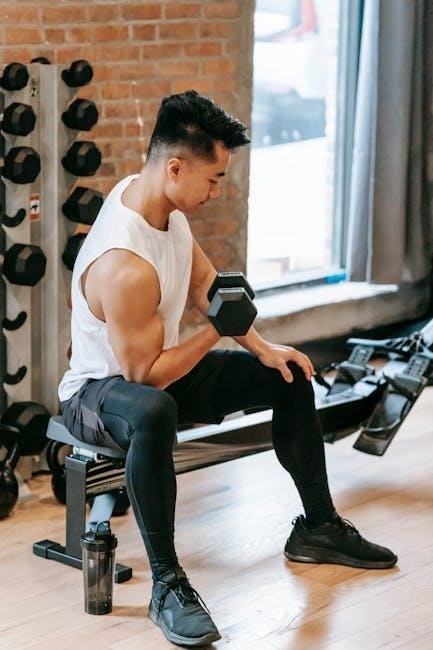
Full Body Workout Without Equipment PDF: A Comprehensive Plan
Discover a revolutionary approach to fitness with our detailed PDF guide, offering effective workouts utilizing only your bodyweight for optimal results.
Embrace convenient, accessible training, eliminating gym costs and time constraints, while achieving a robust and balanced physique through structured routines.
Unlock a healthier, stronger you with our expertly crafted plan, designed for all fitness levels, promoting endurance, strength, and overall well-being.
Bodyweight training, a cornerstone of functional fitness, utilizes your own weight as resistance, offering a remarkably versatile and accessible workout solution. This method transcends the limitations of traditional gym equipment, making it ideal for individuals seeking convenience and cost-effectiveness. Our comprehensive PDF focuses entirely on harnessing this power, providing a structured path to full-body conditioning without needing any external weights or machines.
The beauty of bodyweight exercises lies in their adaptability. From beginner-friendly modifications to advanced progressions, these movements can be scaled to match any fitness level. This PDF will guide you through a range of exercises – push-ups, squats, lunges, planks, and more – demonstrating proper form and offering variations to challenge yourself as you grow stronger. It’s a fantastic option for those with limited space or time, allowing for effective workouts anywhere, anytime.
Furthermore, bodyweight training enhances core stability, improves balance, and builds functional strength – the kind of strength you use in everyday life. This approach isn’t just about aesthetics; it’s about building a resilient, capable body. Prepare to unlock your potential with this empowering and efficient training method!
Benefits of Full Body Workouts
Full body workouts, as detailed in this PDF, offer a multitude of advantages over isolating specific muscle groups. By engaging multiple muscle groups simultaneously, these routines maximize calorie expenditure, boosting your metabolism and accelerating fat loss. This holistic approach promotes balanced muscular development, preventing imbalances and reducing the risk of injury.
Unlike split routines, full body workouts can be performed less frequently, typically 3-4 times per week, allowing for adequate recovery time. This is particularly beneficial for beginners or those with busy schedules. The efficiency of these workouts is remarkable; you’ll achieve significant results in less time compared to traditional training methods.
Moreover, full body sessions enhance hormonal response, stimulating the release of growth hormone and testosterone, crucial for muscle growth and recovery. This PDF provides the tools to unlock these benefits, empowering you to achieve a stronger, leaner, and more functional physique – all without the need for expensive gym memberships or equipment.
Understanding Workout Structure: Circuits & Sets
This PDF utilizes a circuit training structure for optimal full-body engagement. A circuit involves performing a series of exercises, one after the other, with minimal rest in between. This keeps your heart rate elevated, maximizing cardiovascular benefits alongside strength training. Each circuit, as outlined within, targets all major muscle groups, ensuring a comprehensive workout.
Sets and repetitions are crucial components. Typically, we recommend 3-4 sets of each circuit, with 10-15 repetitions per exercise, adjusting based on your fitness level. Rest periods between sets should be around 60-90 seconds to allow for partial recovery. This structure promotes muscular endurance and strength gains.
The PDF details how to modify exercises for varying abilities. Beginners can start with fewer repetitions or easier variations, while advanced individuals can increase the intensity or add challenging progressions. Consistent application of this circuit and set structure will yield significant improvements in your overall fitness.

Warm-Up Exercises (5-10 Minutes)
Prepare your body for intense activity with dynamic movements, increasing blood flow and flexibility, preventing injuries, and maximizing workout effectiveness.
Prioritize joint mobility and muscle activation before each session for optimal performance and a safer, more rewarding fitness experience.
Dynamic Stretching for Full Body Activation
Begin your warm-up with dynamic stretches, controlled movements that prepare your muscles for exercise, unlike static stretches which are held. Include arm circles – forward and backward – to loosen shoulder joints, and torso twists to enhance spinal mobility and core engagement.
Perform leg swings, both forward/backward and side-to-side, to improve hip flexibility and range of motion. Add high knees, bringing your knees towards your chest while walking or jogging in place, activating hip flexors and core muscles. Don’t forget butt kicks, where you attempt to touch your heels to your glutes, targeting hamstrings.
Incorporate walking lunges with a twist, adding a rotational component to engage your core and improve balance. Finish with inchworms, walking your hands forward from a standing position into a plank, then walking your feet towards your hands – a full-body activation sequence. Aim for 10-15 repetitions of each stretch, focusing on controlled movements and proper form.
Cardio Warm-Up: Jumping Jacks & High Knees
Elevate your heart rate and prepare your cardiovascular system with a quick cardio burst. Start with jumping jacks, a classic exercise that engages multiple muscle groups while boosting circulation. Perform three sets of 20-30 repetitions, maintaining a moderate pace and controlled movements.
Transition seamlessly into high knees, bringing your knees as high as possible towards your chest while jogging in place. Focus on driving your knees up and maintaining a quick tempo. Complete three sets of 20-30 repetitions per leg, engaging your core and hip flexors.
Combine these exercises for a dynamic warm-up that increases blood flow to your muscles and prepares your body for more intense activity. Remember to breathe deeply throughout the exercises, and listen to your body, adjusting the intensity as needed. This cardio sequence will prime your system for a successful workout.
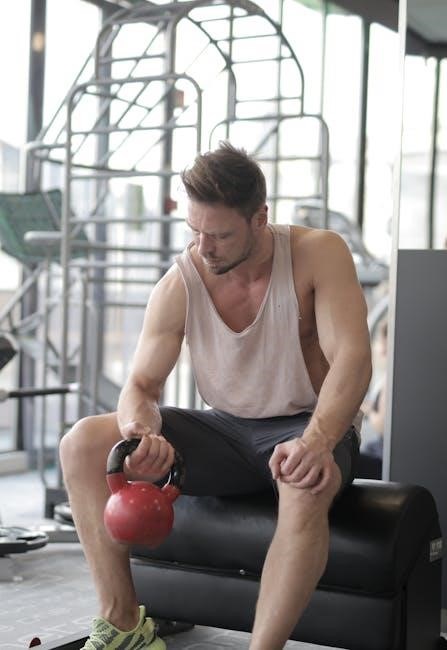
Core Workout Exercises
Strengthen your midsection with targeted exercises like planks, bird-dogs, and Russian twists, building stability and enhancing overall functional fitness effectively.
Plank Variations: Standard, Forearm, Side Plank
Mastering the plank is fundamental for core strength, and variations increase the challenge and target different muscle groups. The standard plank involves maintaining a straight line from head to heels, engaging your abs, glutes, and shoulders. Hold for 30-60 seconds, focusing on proper form to avoid lower back strain.
Forearm planks offer a similar benefit but reduce stress on the wrists. Lower onto your forearms, keeping your elbows directly beneath your shoulders. This variation is excellent for beginners or those with wrist issues. Aim for the same duration as the standard plank.
Side planks target the obliques, improving rotational stability. Lie on your side, propping yourself up on one forearm, keeping your body in a straight line. Hold for 30-45 seconds per side. Modifications include bending your bottom knee for added support. These variations build a strong, resilient core without any equipment!
Bird-Dog Exercise for Core Stability
Enhance your core stability and balance with the Bird-Dog exercise, a fantastic bodyweight movement requiring no equipment. Begin on your hands and knees, ensuring your back is flat. Simultaneously extend your right arm forward and your left leg backward, maintaining a straight line from hand to heel.
Focus on engaging your core to prevent arching or rotating your back. Hold for a few seconds, then return to the starting position and repeat on the opposite side. This exercise strengthens the lower back, glutes, and abdominal muscles, improving posture and reducing the risk of injury.
Perform 3 sets of 10-12 repetitions per side, concentrating on controlled movements. The Bird-Dog is a low-impact exercise suitable for all fitness levels, promoting a strong and stable core foundation for various activities.
Russian Twists (Bodyweight Only)
Strengthen your obliques and core with Russian Twists, a highly effective bodyweight exercise requiring no equipment. Sit on the floor with your knees bent and feet slightly elevated, leaning back slightly to engage your core. Clasp your hands together and twist your torso from side to side, bringing your hands towards the floor.
Maintain a straight back throughout the movement, focusing on twisting from your core rather than swinging your arms. For an added challenge, lift your feet higher off the ground. This exercise improves rotational strength and stability, crucial for various athletic activities.
Complete 3 sets of 15-20 repetitions per side, emphasizing controlled movements. Russian Twists are a versatile exercise adaptable to all fitness levels, building a strong and defined core.
Lower Body Workout Exercises
Target and tone your legs and glutes with our effective exercises, including squats, lunges, and glute bridges – all achievable without any equipment needed!
Bodyweight Squats: Proper Form & Variations
Mastering the bodyweight squat is fundamental for lower body strength. Begin with feet shoulder-width apart, toes slightly outward. Maintain a straight back, chest up, and core engaged throughout the movement. Lower your hips as if sitting into a chair, keeping your weight in your heels.
Ensure your knees track in line with your toes, avoiding inward collapse. Descend until your thighs are parallel to the ground, or as low as comfortably possible. Drive through your heels to return to the starting position, squeezing your glutes at the top.
For variations, try sumo squats (wider stance, toes pointed outward) to emphasize inner thighs, or jump squats for added cardio and explosiveness. Pause squats, holding the bottom position, increase time under tension. Progressive overload can be achieved by increasing repetitions or sets.
Remember to prioritize proper form over depth to prevent injuries and maximize effectiveness.
Reverse Lunges: Targeting Glutes & Hamstrings
Reverse lunges are a fantastic exercise for sculpting your glutes and hamstrings, offering a lower-impact alternative to forward lunges. Start standing tall with feet hip-width apart; Step backward with one leg, lowering your body until both knees are bent at approximately 90-degree angles.
Maintain an upright torso and ensure your front knee stays directly above your ankle. Your back knee should hover just above the ground, avoiding contact. Drive through the heel of your front foot to return to the starting position, squeezing your glutes as you stand.
Variations include adding a twist to engage your core, or holding dumbbells (if available) for increased resistance. Focus on controlled movements and maintaining balance throughout the exercise. Alternate legs with each repetition for a balanced workout.
Prioritize form to maximize glute and hamstring activation and minimize risk of injury.
Glute Bridges: Strengthening the Posterior Chain
Glute bridges are a highly effective exercise for strengthening the posterior chain – encompassing your glutes, hamstrings, and lower back. Begin by lying on your back with knees bent and feet flat on the floor, hip-width apart. Keep your arms relaxed at your sides.
Engage your glutes and core, then lift your hips off the ground, creating a straight line from your shoulders to your knees. Squeeze your glutes tightly at the top of the movement, holding for a brief moment. Slowly lower your hips back down to the starting position.
To increase the challenge, perform single-leg glute bridges, or place a resistance band around your thighs. Focus on controlled movements and maintaining a neutral spine throughout the exercise. This exercise improves hip extension and stability.
Regular practice will contribute to improved posture and athletic performance.
Calf Raises: Improving Ankle Stability
Calf raises are a simple yet crucial exercise for strengthening your calf muscles and enhancing ankle stability, vital for overall lower body health and preventing injuries. Stand with your feet flat on the floor, shoulder-width apart, and maintain a slight bend in your knees.
Slowly rise up onto your toes, lifting your heels as high as comfortably possible. Focus on squeezing your calf muscles at the peak of the movement. Hold this position for a second, then slowly lower your heels back down to the floor.
For increased difficulty, perform single-leg calf raises, or find a slightly elevated surface to increase the range of motion. Proper form is key – avoid rolling your ankles inward or outward.
Consistent practice improves balance and supports athletic endeavors.
Upper Body Workout Exercises
Strengthen and tone your chest, shoulders, and arms with effective bodyweight exercises, requiring no equipment, for a powerful and sculpted upper body physique.
Push-Up Variations: Standard, Incline, Decline
Mastering push-ups is fundamental for upper body strength, and variations offer targeted challenges. The standard push-up engages the chest, shoulders, and triceps, focusing on overall pressing power. Ensure a straight line from head to heels, lowering your chest towards the floor and pushing back up.
Incline push-ups, performed with hands elevated on a stable surface, reduce the difficulty and emphasize the lower chest. This is excellent for beginners or those seeking a modified challenge. Conversely, decline push-ups, with feet elevated, increase the intensity and target the upper chest and shoulders.
Proper form is crucial: maintain a braced core, controlled movements, and avoid arching your back. Experiment with hand placement – wider for chest focus, narrower for triceps. Incorporate these variations into your routine for comprehensive upper body development and to prevent plateaus. Remember to prioritize quality over quantity.
Tricep Dips (Using a Chair or Stable Surface)
Tricep dips are a highly effective exercise for isolating and strengthening the back of your arms. Utilizing a sturdy chair or stable surface, position your hands shoulder-width apart on the edge, fingers pointing forward. Lower your body by bending your elbows, keeping your back close to the chair, until your upper arms are parallel to the floor.
Push back up to the starting position, fully extending your arms. Maintain a controlled tempo throughout the movement, focusing on engaging your triceps. To modify the difficulty, adjust your leg position – bent knees are easier, while extended legs increase the challenge.
Ensure the chair is stable and won’t move during the exercise. Avoid letting your shoulders round forward. This exercise is fantastic for building arm definition and improving upper body strength without any equipment. Incorporate 3 sets of 10-15 repetitions into your routine.
Cardio & Plyometric Exercises
Elevate your heart rate and boost calorie burn with dynamic movements like burpees, mountain climbers, and jump lunges – no equipment needed!
Maximize your fitness gains through explosive exercises, enhancing power and endurance for a complete workout experience.
Burpees: Full Body Conditioning
Burpees are arguably the king of bodyweight exercises, offering a truly full-body conditioning experience with no equipment required. This dynamic movement seamlessly combines a squat, push-up, and jump, engaging multiple muscle groups simultaneously.
Start in a standing position, then drop into a squat with your hands on the floor. Kick your feet back into a push-up position, perform a push-up, and then return your feet to the squat position. Finally, explosively jump upwards, extending your body fully.
Burpees are fantastic for improving cardiovascular health, building strength, and enhancing endurance. They’re a high-intensity exercise, so focus on maintaining proper form to prevent injuries. Beginners can modify by stepping back instead of jumping, and omitting the push-up. Aim for 3 sets of 10-15 repetitions, adjusting based on your fitness level.
Incorporating burpees into your routine will significantly elevate your workout intensity and contribute to overall fitness gains.
Mountain Climbers: Engaging Core & Shoulders
Mountain climbers are a dynamic and effective bodyweight exercise that powerfully engages your core, shoulders, and legs, requiring absolutely no equipment. This exercise mimics the climbing motion, providing a fantastic cardiovascular workout alongside strength training.
Begin in a plank position, ensuring your core is engaged and your body forms a straight line. Bring one knee towards your chest, then quickly alternate, driving your knee towards the opposite elbow. Maintain a rapid, controlled pace, focusing on keeping your hips stable and your core tight.
Mountain climbers are excellent for building core strength, improving shoulder stability, and boosting cardiovascular endurance. Beginners can start with slower repetitions and gradually increase the speed as their fitness improves. Aim for 3 sets of 20-30 seconds, with short rest periods in between.
Regularly incorporating mountain climbers will enhance your overall fitness and contribute to a stronger, more toned physique.
Jump Lunges: Explosive Lower Body Workout
Jump lunges are a high-intensity, plyometric exercise that dramatically enhances lower body power and endurance, requiring zero equipment. This dynamic movement builds strength in your quads, hamstrings, and glutes while simultaneously improving cardiovascular fitness.
Start in a standard lunge position, with one leg forward and bent at 90 degrees, and the other leg extended behind you. Explosively jump upwards, switching the position of your legs mid-air, landing softly in a lunge with the opposite leg forward.
Focus on maintaining good form throughout the exercise, keeping your core engaged and your back straight. Jump lunges are a challenging exercise, so beginners can modify by performing regular lunges before progressing. Aim for 3 sets of 10-12 repetitions per leg.
Integrating jump lunges into your routine will elevate your lower body strength and contribute to a more athletic physique.
Cool-Down & Stretching (5-10 Minutes)
Prioritize recovery with gentle static stretches, holding each for 30 seconds, targeting major muscle groups to improve flexibility and reduce soreness.
Static Stretching for Major Muscle Groups
Following your workout, dedicate 5-10 minutes to static stretching, holding each stretch for approximately 30 seconds. This crucial step enhances flexibility, reduces muscle soreness, and improves overall recovery. Begin with hamstring stretches, gently reaching for your toes while seated or standing, feeling a stretch along the back of your legs.
Next, focus on quadriceps stretches, holding your foot towards your glutes to target the front of your thighs. Don’t forget calf stretches, leaning against a wall with one leg extended back. For upper body, perform triceps stretches by reaching one arm overhead and bending at the elbow, gently pulling the elbow with the opposite hand.
Shoulder stretches can be done by bringing one arm across your body and holding it with the other. Finally, include chest stretches by clasping your hands behind your back and gently lifting your arms. Remember to breathe deeply throughout each stretch, avoiding any bouncing or jerky movements. Consistent static stretching is vital for maintaining muscle health and preventing injuries.
Importance of Post-Workout Recovery
Post-workout recovery is as vital as the workout itself, enabling your muscles to repair and rebuild, leading to improved strength and endurance. Prioritize hydration by replenishing fluids lost during exercise; water is essential, but electrolyte drinks can be beneficial after intense sessions. Nutrition plays a key role – consume protein within an hour post-workout to aid muscle recovery and growth.
Adequate sleep, aiming for 7-9 hours, is non-negotiable, as this is when the majority of muscle repair occurs. Active recovery, such as light walking or foam rolling, can help reduce muscle soreness and improve blood flow. Ignoring recovery can lead to overtraining, increased risk of injury, and plateaus in your progress.
Listen to your body; rest days are crucial. Don’t push yourself when feeling excessively fatigued or experiencing pain. Incorporating these recovery strategies into your routine will maximize the benefits of your bodyweight workouts and ensure long-term fitness success.

Creating Your Full Body Workout PDF
Compile your chosen exercises into a structured PDF, tailoring routines to your fitness level and goals for a personalized, accessible workout plan.
Design a clear, concise document with exercise instructions and sets/reps, ensuring easy understanding and effective implementation of your fitness journey.
Sample Workout Routines for Different Fitness Levels
Beginner Routine: Start with 3 circuits of 10 repetitions each for exercises like bodyweight squats, push-ups (on knees if needed), plank (30 seconds), and bird-dogs. Rest for 60 seconds between circuits. Focus on proper form over speed, building a foundation of strength and stability.
Intermediate Routine: Progress to 4 circuits of 12-15 repetitions. Include exercises like reverse lunges, incline push-ups, forearm plank (45 seconds), and Russian twists. Reduce rest to 45 seconds between circuits. Introduce more challenging variations to increase intensity.
Advanced Routine: Challenge yourself with 5 circuits of 15-20 repetitions. Incorporate burpees, mountain climbers, jump lunges, and decline push-ups. Minimize rest to 30 seconds between circuits. Prioritize explosive movements and core engagement for maximum results. Remember to listen to your body and adjust as needed.
Always prioritize warming up before each workout and cooling down afterward to prevent injuries and enhance recovery.
Tips for Progression and Avoiding Plateaus
Gradual Overload: Consistently increase the difficulty by adding repetitions, sets, or reducing rest time. This challenges your muscles and promotes continued growth. Don’t increase everything at once; focus on one variable per week.
Exercise Variations: Introduce new variations of exercises to target muscles from different angles. For example, switch from standard push-ups to decline push-ups or add plyometric variations like jump squats.
Tempo Changes: Manipulate the speed of your movements. Try slower, controlled repetitions or incorporate explosive movements for increased intensity.
Circuit Adjustments: Modify the circuit structure by changing the exercise order or adding new exercises. This prevents your body from adapting too quickly. Prioritize consistent effort and listen to your body to avoid overtraining.